Building an emergency food supply tends to get filed under “things I’ll do eventually,” right alongside updating the smoke alarm batteries and finding a better health insurance plan. It feels like a big, expensive project that requires a dedicated weekend, a basement full of matching containers, and more money than most households have to spare all at once. So it keeps getting pushed.
The reality is considerably more manageable than that. A basic 3-day supply for a family of four costs roughly $50 to $75 if you shop sales and buy store brands. You don’t need to buy a year’s worth of freeze-dried food in a single trip. You don’t need a specialized pantry or military-grade packaging. What you need is a sensible starting point, a clear list of what to buy, and a habit of adding a few extra items each week until you have something meaningful behind you.
This guide gives you all three, with a focus on keeping costs low without compromising on the foods that actually matter in a real emergency.
Why Emergency Food Storage Actually Matters
The case for keeping an emergency food supply at home doesn’t require worst-case-scenario thinking. The more realistic scenarios include a prolonged winter storm, a job loss that strains the grocery budget for a few weeks, a power outage that runs longer than expected, or a supply disruption that empties store shelves for several days.
FEMA recommends keeping a two-week supply of food and water on hand at all times. That is not a doomsday prepper’s target. It’s a sensible, practical buffer that most financial advisors would endorse for the same reason they recommend an emergency fund: not because catastrophe is inevitable, but because the cost of being unprepared is always higher than the cost of modest preparation.

How Much Food Do You Actually Need?
Getting the quantities right before you start shopping prevents both over-spending and under-preparing. The math is straightforward once you have a few key numbers.
Plan for around 2,000 calories per day for women and around 2,400 calories per day for men. For children aged 6 to 12, roughly 1,500 calories per day is an appropriate planning figure. If an emergency involves significant physical activity, such as clearing debris, hauling water, or managing without utilities in cold weather, increase each adult’s target by 200 to 500 calories.
For a family of four with two adults and two school-age children, a two-week supply requires approximately:
- Adults (x2): 2,200 average calories per day each x 14 days = 61,600 calories
- Children (x2): 1,500 calories per day each x 14 days = 42,000 calories
- Total household requirement: approximately 103,600 calories over two weeks
That sounds like a large number until you recognize what it translates to in actual food. Twenty-five pounds of white rice, twenty-five pounds of dried beans, ten pounds of rolled oats, and a reasonable quantity of canned goods gets you to a two-week calorie base for a family of four for roughly $80 to $120 at standard grocery store prices. The budget is considerably more achievable than most people assume going in.
The Budget-First Approach: Build It Gradually
The most accessible way to build an emergency food supply without financial strain is to treat it as a small addition to every regular grocery trip rather than a single large purchase. Start now by buying a little extra each time you go grocery shopping. This approach allows you to get extra food without breaking the bank.
A practical rule of thumb: add $10 to $15 worth of emergency storage items to each weekly or fortnightly shop. At that pace, a meaningful two-week supply for a family of four can be assembled within two to three months without requiring a dedicated budget line or a lump sum you may not have.
The items that offer the best value for emergency storage are almost all staples you should already be buying, which means you’re not purchasing anything foreign or wasteful. You’re simply buying more of what you already use and setting it aside in a designated area. When you rotate those items into regular meals and replace them on the next shop, nothing expires and nothing goes to waste.
The Core Emergency Pantry: What to Buy First
White Rice
White rice is the single most cost-effective calorie source available at any mainstream grocery store. A large bag of rice will last for years in the pantry and costs about 10 to 20 cents per serving. For emergency storage specifically, white rice is preferred over brown rice because the lower oil content gives it a significantly longer shelf life. Stored in an airtight container in a cool, dry place, white rice lasts up to five years. Sealed in Mylar bags with oxygen absorbers, shelf life extends to 25 years or more.
A 25-pound bag of white rice provides roughly 45,000 calories, making it the most efficient calorie-per-dollar purchase available for emergency food purposes. Buy it in the largest bags your storage space allows.
Dried Beans and Lentils
Beans and lentils pair with rice to form a complete protein, cover fiber needs, and dramatically increase the nutritional value of an emergency food supply built on grains. Beans are the cheapest source of protein there is, plus they give you fiber and minerals. Dried black beans, pinto beans, kidney beans, chickpeas, and lentils all have shelf lives of several years when stored properly and cost very little per serving. Lentils are particularly valuable because they cook in 20 to 30 minutes without pre-soaking, which matters when water and fuel may be limited.
A 25-pound bag of dried beans provides approximately 40,000 calories and costs $20 to $35 depending on the variety and store.
Rolled Oats
Rolled oats cover the breakfast equation in an emergency and provide a reliable, calorie-dense, fiber-rich meal that requires nothing more than hot water to prepare. A 4-gallon pail of quick oats provides 113 servings and costs around $20 at warehouse retailers. Rolled oats keep for one to two years in standard packaging and significantly longer when sealed in airtight containers.
Canned Goods
Canned foods form the flavor and variety layer of an emergency pantry. They require no cooking, provide nutrients that dry staples alone can’t cover, and have a long shelf life that means no food waste, which will always save you money.
The priorities for a budget emergency pantry:
- Canned protein: Tuna, salmon, sardines, chicken, and beans all deliver protein without refrigeration. Canned tuna at $1.00 to $1.50 per can is one of the best value emergency proteins available.
- Canned vegetables: Corn, green beans, peas, mixed vegetables, and diced tomatoes provide nutrients, flavor, and variety at very low cost. Buy the store brand.
- Canned fruit: Peaches, pears, mandarin oranges, and fruit cocktail in juice (not syrup) add sweetness and morale to emergency meals, which matters more than people expect during stressful situations.
- Canned soups and stews: Ready-to-eat soups and chili require no preparation and provide a warm, complete meal with no additional ingredients.
Canned food items are typically good for two to five years, with high-acidity foods such as tomato sauce having a shorter shelf life and low-acidity foods lasting longer.
Peanut Butter
Peanut butter is calorie-dense, high in protein and healthy fat, requires no preparation, and has a shelf life of one to two years in an unopened jar. A two-pound jar costs $4 to $6 and provides around 5,000 calories. It works as a standalone food, a spread, a sauce base, and an energy-dense snack that children will actually eat willingly. This last point is more important than it might seem: emergency food needs to be food your family will actually eat, not just food that theoretically keeps them alive.
Cooking Oil
Fat is the most calorie-dense macronutrient and an essential component of cooking virtually everything on this list. Vegetable oil, olive oil, or coconut oil all store well for one to two years and add essential calories and flavor to rice, beans, and cooked grains. A large bottle of vegetable oil costs $5 to $8 and provides a significant number of servings.
Salt, Sugar, and Basic Spices
This category is easy to underestimate and consistently regretted by those who skip it. Plain rice and beans are sustaining but deeply monotonous without seasoning. Salt is a preservation tool as well as a flavoring agent. Sugar adds calories and palatability to oatmeal and hot drinks. A small investment in garlic powder, onion powder, chili flakes, and cumin can transform an emergency pantry meal from something you endure to something you can actually enjoy. Dried herbs and spices have shelf lives of one to three years and cost very little per jar.
Honey
Honey is one of the few foods with an essentially unlimited shelf life when stored sealed in a dry environment. It adds significant calories, works as a sweetener and a spread, has mild antimicrobial properties, and costs $6 to $10 for a large jar. It’s a worthwhile addition to any emergency pantry and an ingredient that never needs rotation.
Water: The Non-Negotiable Priority
No emergency food storage plan is complete without water, and it’s worth addressing directly rather than as an afterthought. FEMA recommends at least 1 gallon per person per day for drinking and sanitation combined. For a family of four, a two-week supply requires a minimum of 56 gallons.
Storing 56 gallons is impractical for most households, which is why water storage is best approached as a layered system. Keep a minimum of three days of bottled water on hand (around 12 gallons for a family of four), have a backup water purification method such as a filtered water bottle or purification tablets, and know where your nearest clean water sources are. The water aspect of emergency preparedness often costs less than $30 to start and is more important than anything else on this list.
What to Avoid Buying for Emergency Storage
Knowing what not to buy is as useful as knowing what to buy, particularly on a tight budget where every dollar spent on the wrong item is a dollar not spent on something that actually adds value.
Specialty freeze-dried meals are the most common budget trap in emergency preparedness. Pre-packaged emergency food kits are heavily marketed and come with appealing shelf-life claims, but the cost per calorie is dramatically higher than building your own supply from scratch. A 30-day single-person emergency food pail costs around $190 and provides roughly 1,236 calories per day, which is below the recommended intake. The same $190 spent at a grocery store on rice, beans, oats, and canned goods produces considerably more food at considerably more calories per day. Freeze-dried meals have a place in emergency preparedness for their convenience and very long shelf life, but they are not a good value as the foundation of a budget emergency supply.
Foods your family doesn’t already eat are also a poor investment. Storing foods that are difficult to prepare and are unlikely to be eaten could be a costly mistake. An emergency is not the time to develop a taste for unfamiliar foods. Stick to ingredients you already cook with, scaled up to emergency quantities.
Storage: Keeping Your Investment Safe
The best food supply in the world is worthless if it’s stored incorrectly. The enemies of shelf-stable food are heat, humidity, light, oxygen, and pests, and every storage decision should be made with those five factors in mind.
Temperature is the most important variable. Keeping your food under 72 degrees is important to get the maximum shelf life. For every 10 degrees above that, shelf life decreases meaningfully. Avoid storing emergency food in garages, attics, or anywhere that experiences significant temperature swings.
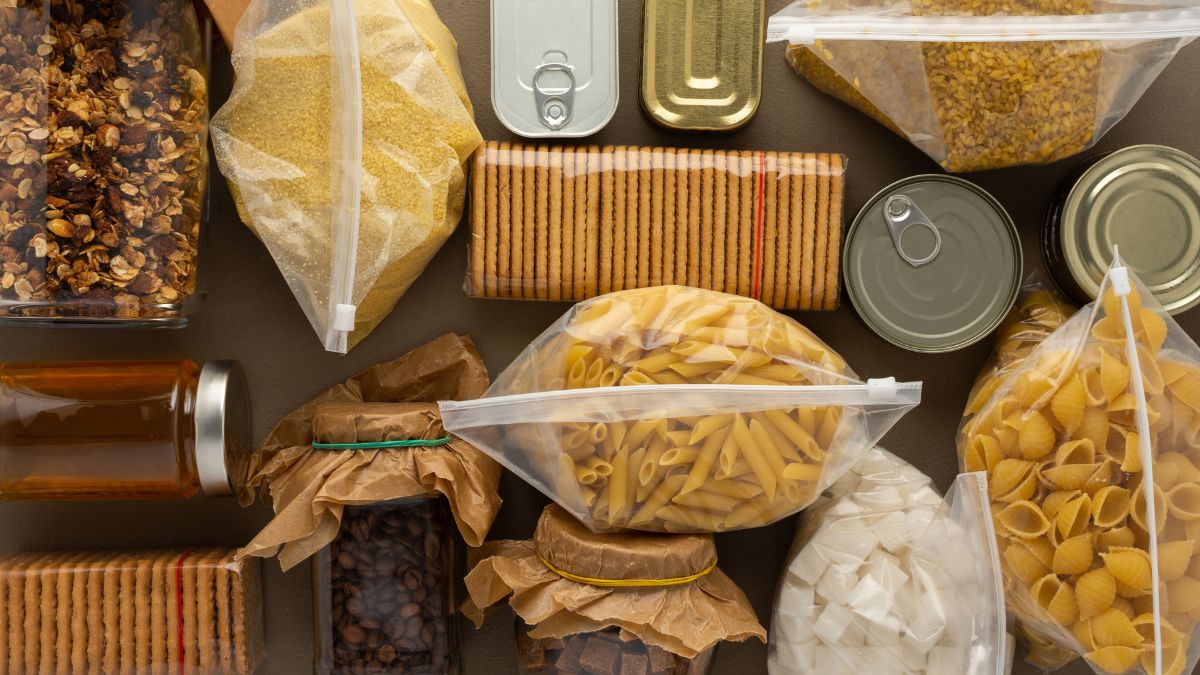
Airtight containers extend shelf life substantially for dry goods like rice, oats, and beans. Food-grade buckets with gamma-seal lids, large glass jars, and quality zip-lock bags all work well. For very long-term storage, Mylar bags with oxygen absorbers inside food-grade buckets are the most effective and affordable option available.
For households without a dedicated storage area, the solutions are more creative but entirely workable. Closets and under-bed storage work well, especially totes that keep everything organized and easy to access. A case of canned goods under a bed, a bucket of rice in a closet, and a shelf of canned protein in a spare cupboard constitutes a meaningful emergency supply without requiring any dedicated space.
Rotating Your Stock: The Habit That Makes It Sustainable
Emergency food storage only works as a long-term system if the food stays fresh, and the food only stays fresh if it gets used and replaced regularly. The rotation principle is simple: use the oldest items first and replace them with new ones at the back of the supply.
The most practical way to manage this is to integrate your emergency pantry with your regular pantry rather than keeping them completely separate. When you open a can of beans from your emergency supply, replace it on the next grocery trip. When a bag of rice drops below a certain level, buy a new one to replenish. This approach means nothing expires, nothing goes to waste, and you’re always eating food that is within its best-quality window.
Label containers with the purchase date using masking tape and a marker. Check your supply twice a year, rotating and replacing anything approaching the end of its best-quality window. A few hours twice a year is all the maintenance this system requires once it’s built.
A Tiered Budget Starting Point
If you want a concrete starting framework, here are three entry points based on what a household can reasonably spend to get started.
Tier 1: Around $50 to $75 (3-day supply for a family of four) This tier covers the immediate short-term emergency and is achievable in a single grocery trip. It should include canned tuna, canned beans, canned soup, peanut butter, crackers, canned fruit and vegetables, and a supply of bottled water. Focus on foods that require no cooking in case of a power outage.
Tier 2: Around $150 to $200 (two-week supply for one to two people) This tier adds the bulk staples: a 10-pound bag of white rice, a 5-pound bag of dried lentils or beans, a bag of rolled oats, cooking oil, and an expanded canned goods selection. Combined with the Tier 1 supplies, this is a meaningful emergency cushion that covers most realistic disruption scenarios.
Tier 3: Around $300 to $500 (one month’s supply for a family of four, built over time) At this level, you have a genuine food security buffer. A 25-pound bag of rice, 10 pounds of dried beans, a large container of oats, a full case of assorted canned goods, peanut butter, cooking oil, honey, salt, and a basic spice kit. Built gradually over two to three months by adding $15 to $20 worth of emergency items to each regular grocery trip, this level is financially accessible without requiring a lump-sum investment.
The Bottom Line
Emergency food storage on a budget is not a complicated project when approached correctly. The most expensive version of it, pre-packaged freeze-dried meal kits, is also the least necessary version. The most practical version is built from the same staples you already cook with, bought in slightly larger quantities, stored correctly, and rotated regularly into your everyday meals.
Start small, add consistently, and prioritize foods your family actually eats. A three-day supply is better than nothing. A two-week supply is what FEMA recommends. A one-month supply is a meaningful financial and practical safety net that costs less to build than most people assume. You don’t need to do it all at once, and you don’t need a special budget to start today.